The Great Data Decoupling: How Personal Data Oracles Architect Digital Autonomy
AI
2/25/20264 min read
1. Introduction: The Hostage Crisis in Your Pocket
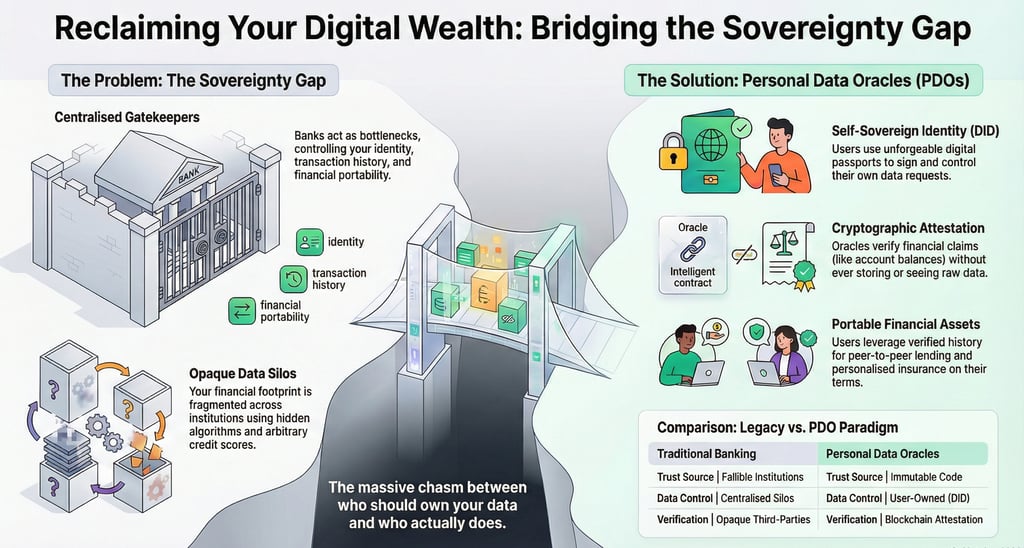
Your most valuable asset—your digital identity—is currently being held hostage. Every transaction, every certification, and every heartbeat of your online existence is trapped within corporate vaults, dissected by opaque algorithms you didn't choose and cannot influence. We are living in a profound "Sovereignty Gap": a systemic chasm between the immense value your data generates and the zero-sum control you possess over it. But the era of data captivity is ending. We are not merely witnessing a shift; we are architecting the structural collapse of legacy gatekeepers. By leveraging Personal Data Oracles, we are bridging this gap, transforming digital sovereignty from a theoretical ideal into a verifiable, high-stakes reality.
2. Your Bank is a Bottleneck, Not a Vault
Traditional banking is operating on a foundation of centralized trust that is visibly cracking under the weight of the digital age. For decades, we have been told these institutions are vaults for our wealth, yet they have morphed into bottlenecks for our potential. They act as self-appointed gatekeepers to your money, your identity, and your history, enforcing a fragmented infrastructure where your financial footprint is siloed and vulnerable.
This legacy model relies on a frustrating lack of portability, keeping your own data out of your reach while utilizing it for institutional gain.
"It’s like trying to navigate a digital world with a paper map from the 1800s!"
These obsolete chains are the primary inhibitors of human agency in the modern economy. When the foundation is a crumbling relic of the 20th century, the only solution is to build a new architecture entirely.
3. Attestation is the New Storage
Personal Data Oracles represent the most significant paradigm shift in cryptographic history. The central flaw of the old world was the "honey pot" problem: the belief that to verify data, an institution must store it. Oracles shatter this necessity. Instead of acting as a database for raw, sensitive information, these oracles function as a secure, cryptographic bridge that attests to claims.
In this new model, trust is moved from fallible, biased institutions to immutable, verifiable code. Oracles provide zero-knowledge validation—the ability to prove you have a specific financial status or professional credential without ever revealing the underlying raw data. You transmit the value of the information without the risk of it being copied, harvested, or stolen. This is the ultimate privacy game-changer: moving from a world of "blind trust" in humans to "verifiable truth" in mathematics.
4. The Rise of the Self-Sovereign Digital Passport
The engine of this reclamation is Decentralized Identity (DID). Consider a DID your unforgeable, self-sovereign digital passport—a credential controlled entirely by you, not a government or a silicon valley conglomerate.
The interaction between a user, their DID, and an oracle creates a seamless cryptographic handshake:
User Initiation: You use your private key to sign a request through your DID.
Oracle Validation: The oracle reaches into a data source to verify a specific fact (e.g., "this individual has maintained a positive balance for five years").
Cryptographic Attestation: The oracle generates a verifiable proof of this fact without exposing your bank statements.
Peer-to-Peer Authentication: This "attestation" is posted to a blockchain, allowing decentralized applications to grant you access or credit instantly based on a "mathematical certainty" rather than a permissioned request.
5. The Death of the Centralized Credit Score
As your financial footprint becomes a portable asset, the centralized credit score—that shattering relic of 20th-century surveillance—becomes irrelevant. Current credit scores are merely "someone else’s interpretation" of your life, dictated by credit bureaus using hidden agendas.
We are replacing these arbitrary metrics with a verifiable history of your actual financial behavior. When you apply for a loan in the decentralized frontier, you aren't begging a middleman for a favor; you are presenting an oracle-verified record on your own terms.
"Trust is earned through transparent code, not mandated by institutions."
The FICO meter is breaking. In its place, we are installing a system where your financial history is a strength you leverage, not a metric used to colonize your future.
6. Turning Your Digital Life into a Liquid Asset
In the emerging financial paradigm, data transitions from a liability into "liquid gold." By closing the sovereignty gap, you effectively become the CEO of YOU. This isn't just about privacy; it's about governance.
When your data is a liquid asset, you gain the power to monetize or minimize your footprint at will. You dictate the conditions of access. You decide who sees what, for how long, and for what price. This level of agency transforms you from a data point to be harvested into a sovereign entity with a portable, verifiable value. Your digital life is no longer a trail of breadcrumbs for advertisers—it is the capital with which you build your future.
7. Conclusion: The Revolution is Verifiable
The Sovereignty Gap is closing, and the old guards of institutional mandate are being replaced by the cold, beautiful certainty of code. Through the synergy of Personal Data Oracles and Decentralized Identity, we are creating a world where your identity is resilient, self-sovereign, and unequivocally yours. This is the end of the hostage crisis. We are entering an era where freedom is no longer a promise made by a bank—it is a verifiable reality.
The question is no longer about whether the technology exists. The question is: Are you ready to reclaim your currency, or will you continue to let your life be someone else's profit?